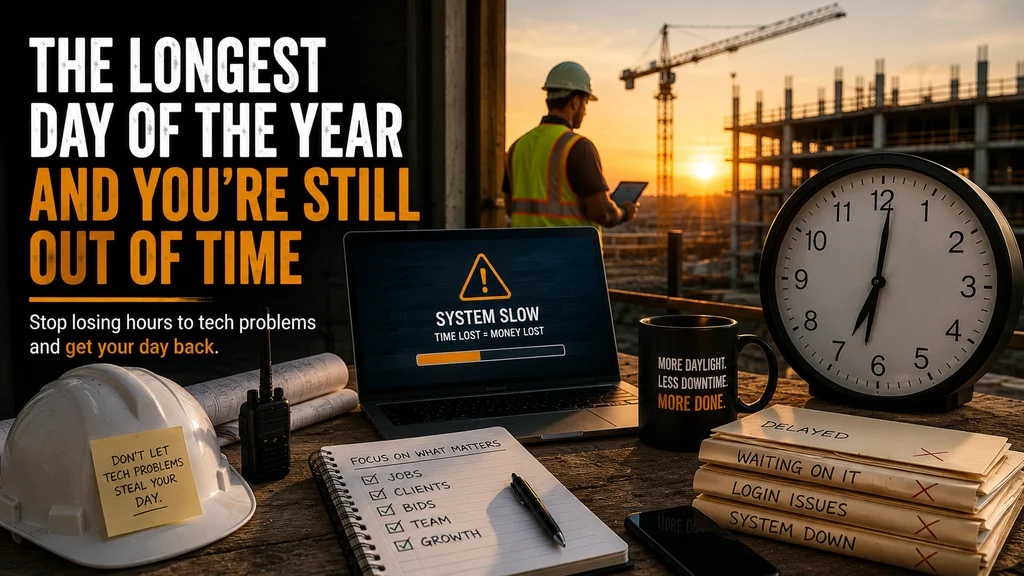
Every year around late June, Texas gives us the longest day of the year.
More daylight.
More usable hours.
More time to get things done.
At least, that is how it sounds on paper.
But if you run a construction company, you know better.
That extra daylight disappears fast.
The day starts with a full schedule and good intentions. Then the phone starts ringing. A superintendent needs an answer. A project manager cannot find the latest file. A vendor invoice needs approval. The job trailer Wi-Fi is acting up. A crew is waiting on updated drawings. Accounting needs access to a system that is not loading. An owner wants a status update before lunch.
Before you know it, the longest day of the year feels short.
And that raises a hard question:
If even the longest day does not feel like enough, is time really the problem?
Most of the time, it is not.
The Day Does Not Fall Apart All at Once
Very few construction days start in chaos.
Most start with a plan.
You know what jobs need attention. You know which meetings matter. You know which bids, approvals, schedules, and decisions need to move forward.
Then one small issue pulls somebody off track.
A project manager cannot log in.
A shared folder will not load.
A file is missing.
A field tablet needs an update.
A system takes too long to respond.
The Wi-Fi slows down in the trailer.
A report has to be rebuilt because two systems do not match.
None of these feel like major problems by themselves.
But each one causes a stop.
Somebody has to pause what they are doing, chase the issue, ask for help, find a workaround, resend the file, restart the device, or call the person who “usually knows how to fix it.”
That shift is where time starts leaking.
By the time they get back to the work that actually matters, they have lost more than a few minutes.
They have lost focus.
They have lost momentum.
And in construction, momentum matters.
It Is Not About Having More Time
Most construction companies do not lose time in one big dramatic event.
They lose it in small, constant interruptions.
A slow login.
A bad connection.
A missing file.
A software glitch.
A printer problem.
A laptop that needs a reboot before a meeting.
A field user who cannot access the latest drawings.
A project manager who has to enter the same information into two different systems.
A superintendent who has to call the office because the tool in the field is not working.
Individually, these feel minor.
Together, they steal hours.
And because they happen a little at a time, they rarely show up clearly on a report.
Nobody adds a line item for “lost momentum.”
Nobody tracks “time spent hunting for files.”
Nobody creates a job cost code for “waiting on the system to load.”
But you feel it.
Your team feels it.
The schedule feels it.
The margin feels it.
The truth is, you probably do not need longer days.
You need fewer leaks in the day you already have.
More Hours Will Not Fix a Broken Workflow
When a company is constantly behind, the instinct is usually to push harder.
Work longer.
Start earlier.
Stay later.
Hire another person.
Add another meeting.
Buy another tool.
Sometimes that helps for a little while.
But if the underlying workflow is broken, adding more hours does not solve the problem. It just gives the problem more room to spread.
If your systems are slow, your team loses time.
If your files are disorganized, your team loses time.
If your software does not talk to itself, your team loses time.
If every IT issue has to be escalated through three people before anyone knows what to do, your team loses time.
If nobody is monitoring your technology until something breaks, your team loses time.
Now, here’s the kicker:
When you add more people to a broken workflow, you do not always gain capacity.
Sometimes you just multiply the interruptions.
Smooth Companies Do Not Just Manage Time Better
Companies that run smoothly are not magic.
They are usually better at preventing avoidable drag.
Their systems are monitored.
Their devices are maintained.
Their software is patched.
Their backups are checked.
Their access is organized.
Their file structure makes sense.
Their support process is clear.
Their recurring issues get fixed at the root instead of worked around forever.
That does not mean nothing ever goes wrong.
Construction is construction.
Things will always pop up.
But when technology is handled well, those problems do not take over the day.
People know where to go.
Issues get resolved faster.
The same problem does not keep showing up every week.
Your team does not have to become its own help desk.
And leadership is not constantly dragged into tech issues that should have been handled before they interrupted the work.
That is the difference.
Good IT does not give you more hours in the day.
It helps you stop wasting the ones you already have.
The Real Cost Is Focus
Lost time is bad enough.
Lost focus may be worse.
When a project manager gets pulled away to troubleshoot access, they are not reviewing schedule risk.
When accounting is stuck dealing with a login issue, they are not closing the month.
When a superintendent cannot pull up current drawings, they are not leading the field.
When the operations team keeps dealing with the same recurring tech problems, they are not improving the business.
That is where small interruptions become expensive.
They do not just delay tasks.
They pull your best people away from the work only they can do.
Ain’t nobody got time for that.
Especially not in a business where deadlines, labor, materials, and margins are already tight.
A Quick Gut Check for Your Management Team
Before your next leadership meeting, ask these questions:
- How many recurring technology issues did our team deal with this week?
- Are our project managers losing time to slow systems, missing files, or duplicate entry?
- Can field teams access what they need without calling the office?
- Are we fixing root causes or just working around the same problems?
- Does our IT support process move fast enough for construction?
- Are systems monitored before they break, or only after someone complains?
- Do we know which tools are helping productivity and which are slowing us down?
- If we added five new employees tomorrow, would our current workflow hold up?
If those questions make the room a little uncomfortable, good.
That means there is time hiding in your business.
You just have to stop the leaks.
Technology Should Not Be a Daily Distraction
You built your business to build.
Not to chase logins.
Not to troubleshoot Wi-Fi.
Not to hunt for files.
Not to restart devices.
Not to babysit software.
Not to have your best people lose half the morning to problems that should have been prevented.
Technology should support the work quietly in the background.
It should help your people move faster, communicate better, protect data, access the right information, and keep jobs moving.
When it does that, the day feels different.
Not because there are magically more hours.
But because fewer of them get wasted.
Where We Come In
We help construction companies across Texas stop losing time to messy, reactive IT.
That means monitoring systems, maintaining devices, supporting users, cleaning up access, improving workflows, strengthening cybersecurity, and fixing recurring problems before they keep stealing hours from your team.
No jargon.
No finger-pointing.
No “just submit a ticket and wait.”
Just practical IT support built around how construction actually works.
If your longest days still feel too short, the problem may not be the clock.
It may be the leaks.
Call us at 214-253-0643 or schedule a discovery call.
Let’s help your team get more of the day back.