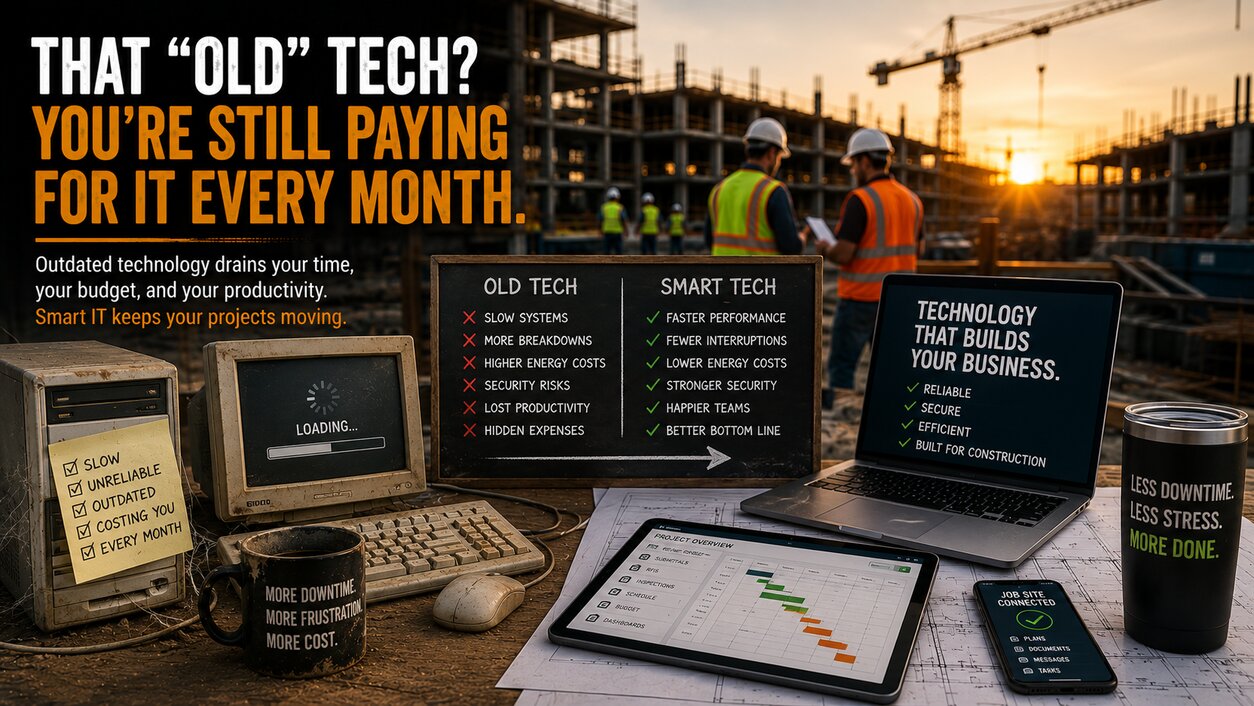
Most construction companies hang on to old technology for the same reason they hang on to an old pair of work boots.
They’re worn down. They’re uncomfortable. They probably should have been replaced a while ago.
But they still technically work.
So the slow desktop in estimating stays. The job trailer router keeps limping along. The aging server in the closet keeps humming. The old laptop nobody wants keeps getting handed to the next person who “only needs it for email.”
On paper, that feels practical. Why spend money replacing something that still turns on?
But outdated technology has a way of charging you anyway.
Not with one big obvious invoice. It shows up through slow systems, wasted time, frustrated employees, recurring support calls, security gaps, and interruptions that keep your team from doing the work they were hired to do.
Old technology does not have to be completely broken to cost you money.
Sometimes “barely working” is the most expensive kind of working there is.
The Hidden Cost of “Still Works”
Construction leaders are practical by nature. You don’t throw away a truck because it has a few dents. You don’t replace a tool just because it has scratches. If something still does the job, you try to get a little more life out of it.
That mindset makes sense when margins matter.
But technology is different because it rarely fails all at once. It gets slower. It gets less reliable. It needs more attention. It struggles with newer software. It becomes harder to secure. It creates workarounds your team slowly accepts as normal.
That is where the real cost starts.
A project manager waits too long for a laptop to start before an owner meeting. An estimator loses time because bid documents take forever to open. A superintendent cannot access updated drawings because the tablet is too old to run the latest app. Accounting restarts the same workstation twice a week before running reports.
None of those problems feel like a crisis by themselves.
But they all slow the company down.
And in construction, slow gets expensive.
You Pay for Old Tech in Lost Time
The biggest cost of outdated technology is usually time.
A few minutes waiting for a system to load. A few more minutes restarting a device. Another delay while someone searches for a file that should have opened right away. A call to the office because the field tool is not working. A second attempt because the first one froze.
Individually, those moments are easy to dismiss.
But construction runs on timing. When the right person cannot get the right information at the right moment, the ripple effect is real.
A delayed RFI response can affect the field. A slow estimating system can affect the bid. A missing file can hold up a project manager. A weak job-site connection can slow down a superintendent. A sluggish accounting system can delay billing.
Nobody creates a job cost code for “waiting on technology.”
But the cost is there.
Your people feel it. Your schedule feels it. Your margin feels it.
You Pay for Old Tech in Frustration
Your best people do not want to spend their day fighting computers, printers, routers, tablets, or software.
They want to build, manage, estimate, coordinate, bill, and lead.
But when the same technology problems keep showing up, frustration builds. Project managers get tired of fighting systems. Estimators get tired of waiting on files. Accounting gets tired of frozen workstations. Field teams get tired of tools that work fine in the office but fall apart on-site.
Eventually, people stop reporting the problem.
They just work around it.
That may be the most expensive part of all.
Because once your team accepts bad technology as normal, the waste becomes invisible. People build their own shortcuts. They save files in the wrong places. They avoid certain systems. They use personal devices. They text documents because the official process is too slow.
That is not efficiency.
That is survival.
You Pay for Old Tech in Support Costs
Older equipment usually needs more attention.
More troubleshooting. More patches. More restarts. More emergency fixes. More time from internal staff or outside support.
At some point, you are no longer saving money by keeping the old system alive. You are paying rent on the problem.
A repair here and there is normal. Every company has devices that need attention from time to time.
But when the same machines, connections, or systems keep causing trouble, the question changes. It is no longer, “Can we fix it again?”
The better question is, “How much are we spending to keep this problem in place?”
If your IT support is constantly nursing outdated equipment instead of improving the environment, your old technology is not just slowing down your team. It is slowing down your progress.
You Pay for Old Tech in Risk
This is the part that should get management’s attention.
Outdated technology can create real security problems.
Unsupported systems may no longer receive security updates. Old devices may not run modern protection tools well. Outdated software may have known vulnerabilities. Forgotten equipment may still have access to company data. Backups may become unreliable because aging infrastructure cannot keep up.
That matters because construction companies handle sensitive information every day.
- Project files.
- Drawings.
- Contracts.
- Bids.
- Payroll.
- Vendor records.
- Banking information.
- Owner communications.
- Insurance documents.
- W-9s.
- Lien waivers.
If that information is exposed, lost, or locked up because of a preventable technology issue, nobody cares that the old system was “still working yesterday.”
They care that the business was left vulnerable.
Old Tech Can Hold Back New Tools
There is another cost that does not always get noticed right away.
Old technology can keep your company from getting full value out of newer tools.
Maybe you invested in cloud collaboration, but your file structure is still a mess. Maybe your project management platform is powerful, but field devices are too slow to use it well. Maybe leadership wants better reporting, but your systems do not connect cleanly. Maybe you are paying for modern software while the environment underneath it still operates like it is ten years behind.
That is frustrating.
It is also expensive.
Because now you are paying for new tools while old technology keeps your team from using them properly.
The tool may be modern. But if the foundation underneath it is weak, the results will still disappoint.
Replacement Does Not Mean Replacing Everything
This is where a lot of construction leaders hesitate.
They hear “outdated technology” and assume someone is about to recommend a massive replacement project.
That should not be the goal.
The goal is not to spend more. The goal is to spend smarter.
Some equipment may be fine. Some systems may only need maintenance. Some devices can wait. Some should be upgraded soon. And some should have been replaced a year ago.
The right approach is to look at the whole environment and build a practical plan.
What is costing more than it is worth? What creates the most daily friction? What carries the most risk? What affects the most people? What is likely to fail soon? What can wait? What cannot?
That kind of plan helps you stop guessing.
It also helps you avoid emergency decisions, which are almost always more expensive.
What Happens When You Stop Paying for Problems
When outdated technology is handled the right way, the difference is easy to feel.
Systems start faster. Files open when they should. Job-site connections become more reliable. Devices can run the tools your teams actually need. Support calls go down. Workarounds start disappearing. Security improves. Backups become more dependable.
Your team spends less time waiting and more time working.
Leadership hears fewer complaints about the same recurring issues.
The day runs smoother.
Not perfect. Construction is never perfect.
But smoother matters.
A smoother day means fewer interruptions, faster decisions, better communication, and less drag on the people responsible for keeping jobs moving.
A Quick Gut Check for Your Management Team
Before your next leadership meeting, ask a few honest questions.
- Which devices or systems cause the most complaints?
- Which computers, servers, routers, tablets, or printers are past their useful life?
- Are any systems running software that is no longer supported?
- Are old devices still accessing company files, email, or project systems?
- Are field teams avoiding company tools because the devices are too slow or unreliable?
- Are you spending more to support old systems than it would cost to replace them?
- Do you have a replacement plan, or are you waiting for something to fail?
If you do not know the answers, that is not a failure.
It just means old technology may be making decisions for you.
And that is not where you want to be.
Do Not Wait for the Breakdown
Waiting until technology breaks may feel cheaper.
It usually is not.
By the time something fails, you are buying under pressure. Your team is down. The work is interrupted. The replacement is rushed. The cost is no longer just the equipment. It is the disruption.
Planned replacement is different.
You can budget for it. Schedule it. Prepare your team. Avoid unnecessary downtime. Make a smart decision instead of a panicked one.
That is how construction companies should handle technology.
The same way you handle the job.
Plan it before it becomes a problem.
Where We Come In
We help construction companies across Texas stop overpaying for technology that is not pulling its weight.
That means identifying outdated systems, reviewing risk, prioritizing replacements, recommending right-sized upgrades, and building a practical plan that fits your business.
No scare tactics.
No unnecessary hardware push.
No replacing things just because they are old.
Just clear guidance on what is working, what is costing you, what can wait, and what needs attention now.
Then we help manage the transition so your team is not left dealing with the mess.
If your systems are slow, your team is frustrated, or you are tired of paying to keep outdated technology barely alive, it may be time for a closer look.
Call us at 214-253-0643 or schedule a discovery call.
Old technology may feel paid off.
But if it is slowing down your people, interrupting your work, and increasing your risk, you are still paying for it every month.