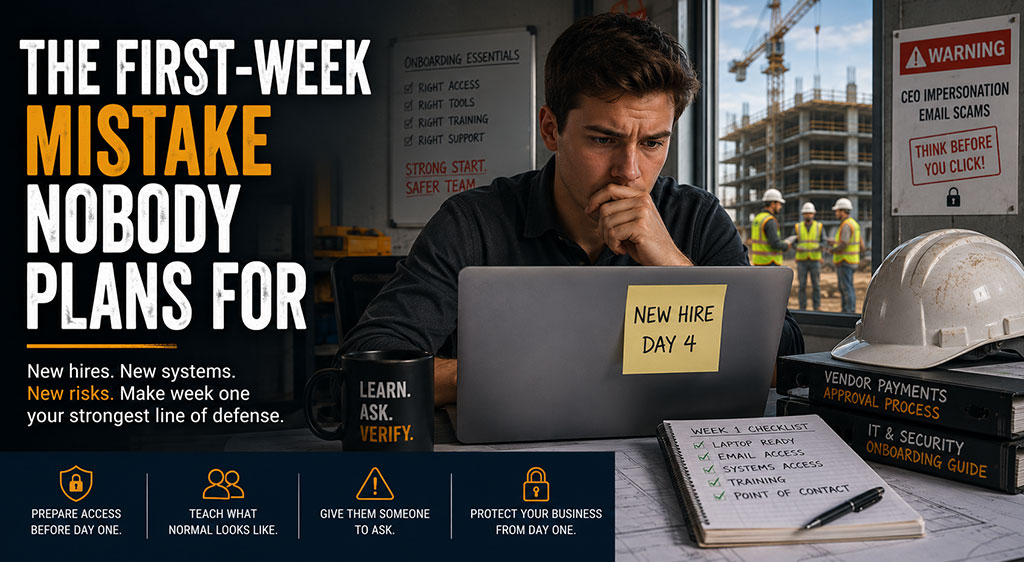
The email shows up on a Tuesday morning.
It looks like it came from the owner.
The name is right. The tone sounds familiar. Even the signature looks normal.
“Hey — can you help me with something quickly? I’m tied up in meetings. Need you to handle this vendor payment. I’ll explain later.”
The new employee pauses.
They have been with the company for four days. They are still learning the systems, still figuring out who approves what, and still trying to make a good first impression.
They do not know what is normal yet.
And they sure do not want to be the person who questions the owner in their first week.
So, they help.
And just like that, the damage is done.
The First Week Is a Dangerous Week
Construction companies bring on new people all the time.
Project coordinators. Assistant project managers. Accounting staff. Estimators. Office admins. Interns. Field support. Safety assistants. New supers. New operations hires.
Some are experienced. Some are fresh out of school. Some are seasonal. Some are filling a role that needed help yesterday.
Either way, the first week is a vulnerable window.
Not because new employees are careless.
Usually, it is the opposite.
They want to help. They want to prove themselves. They want to move fast, fit in, and not slow anybody down.
That is exactly what criminals count on.
A new hire does not always know how your company handles vendor payments. They do not know whether the CEO texts urgent requests. They do not know who approves wire transfers. They do not know if project managers normally share files through email, Teams, Procore, or some folder buried six levels deep.
They do not know the rhythm yet.
And when everything feels new, even a suspicious request can look like just another thing they have not learned yet.
Now, here’s the kicker:
The most dangerous employee is not always the careless one.
Sometimes it is the helpful one.
The Problem Usually Starts Before the Phishing Email
Think about a typical first day.
The laptop is not ready.
The email account is still being set up.
The new employee does not have access to the shared drive yet.
Someone says, “Just use my login for now.”
A project file gets saved to the desktop because permissions are not working.
The new hire uses a personal phone to check something because it is faster.
Nobody has explained who to call when something feels off.
None of that feels like a big deal in the moment.
It feels like construction.
People improvise. They solve problems. They keep moving.
But technology does not treat those little shortcuts as harmless.
Shared logins create blind spots.
Personal devices create risk.
Local files can miss backups.
Wrong permissions can expose sensitive information.
Unclear approval processes create openings for fraud.
And a new employee who does not know the rules yet may not realize they are standing in the middle of one.
The attack did not create the vulnerability.
The first day did.
Construction Has More Moving Parts Than a Regular Office
This matters even more in construction because your business does not run from one clean, controlled office.
You have people in the field.
People in the office.
People in trucks.
People in job trailers.
People using tablets.
People reviewing drawings on phones.
People approving change orders between meetings.
People sending bids, contracts, invoices, lien waivers, payroll information, W-9s, project documents, and owner communications all day long.
That is a lot of sensitive information moving through a lot of hands.
And new employees are often dropped right into the middle of it.
They may be asked to access Procore, PlanGrid, Microsoft 365, QuickBooks, Sage, Foundation, Bluebeam, Dropbox, SharePoint, email, payroll systems, banking portals, or whatever mix of tools your company uses.
If onboarding is messy, your risk goes up fast.
Not because your people are bad.
Because the system is unclear.
Helpful People Need Clear Guardrails
Most first-week security mistakes do not happen because someone ignores the rules.
They happen because nobody explained the rules in a way that stuck.
A new employee should not have to guess whether a payment request is real.
They should not have to wonder who approves vendor changes.
They should not have to borrow a login.
They should not have to save files wherever they can just to get through the day.
They should not have to decide whether an email from “the CEO” feels legitimate while they are still trying to remember where the break room is.
That is asking too much.
The better move is to give them clear guardrails before the pressure hits.
What a Prepared First Day Looks Like
A secure first day does not require a three-hour cybersecurity lecture.
Ain’t nobody got time for that.
But it does require a plan.
1. Their access is ready before they arrive.
The laptop is configured.
The email account works.
Multi-factor authentication is set up.
Permissions match the job role.
The right apps are installed.
The employee knows where files live.
No borrowed logins.
No “we’ll fix that later.”
No temporary workaround that becomes permanent.
2. They know what normal looks like.
This can be a ten-minute conversation.
Do owners or executives ever request payments by email?
Who approves vendor changes?
How are banking details verified?
Where should project files be shared?
What does a legitimate request look like?
What should they do if something feels off?
You are not trying to scare them.
You are giving them confidence.
3. They know who to ask.
This may be the most important piece.
New employees do not want to look foolish.
So, when they are unsure, they may stay quiet.
Give them a person.
Give them a process.
Tell them directly:
“If anything feels strange, stop and ask. You will never get in trouble for double-checking.”
That one sentence can save you a lot of pain.
The First Week Should Be Built, Not Improvised
Construction leaders understand sequencing.
You do not pour concrete before the forms are ready.
You do not send crews to a site without plans.
You do not start a job hoping the right materials show up eventually.
Onboarding should work the same way.
Before a new employee starts, someone should know:
What device do they need?
What systems do they need access to?
What permissions should they have?
What data should they not see?
What security tools need to be installed?
What approval processes do they need to understand?
Who do they call when something seems wrong?
That is not overcomplicating things.
That is doing the work in the right order.
A Quick Gut Check for Your Next Hire
Before your next new employee walks in the door, ask your management team these questions:
- Will their laptop, email, and apps be ready on day one?
- Will they have their own login for every system they need?
- Will multi-factor authentication be set up correctly?
- Will their permissions match their actual role?
- Will someone explain how payment requests, vendor changes, and sensitive files are handled?
- Will they know who to ask before clicking, sending, paying, or sharing something questionable?
- Will your IT team know they are starting before they show up?
If the answer is no to any of those, you found the gap.
And it is a lot easier to fix that gap before the phishing email arrives.
Where We Come In
We help construction companies across Texas make technology safer, cleaner, and easier to manage.
That includes onboarding.
We help make sure new employees have the right devices, the right access, the right protections, and the right security guardrails before they are dropped into the middle of a busy workweek.
No shared logins.
No mystery permissions.
No first-day scramble.
No guessing who can access what.
Just practical IT support built around how construction companies actually operate.
Because your new employees should be focused on learning the job.
Not dodging cyber traps they were never prepared to recognize.
Call us at 214-253-0643 or schedule a discovery call.
The best time to close that door is before someone walks through it.