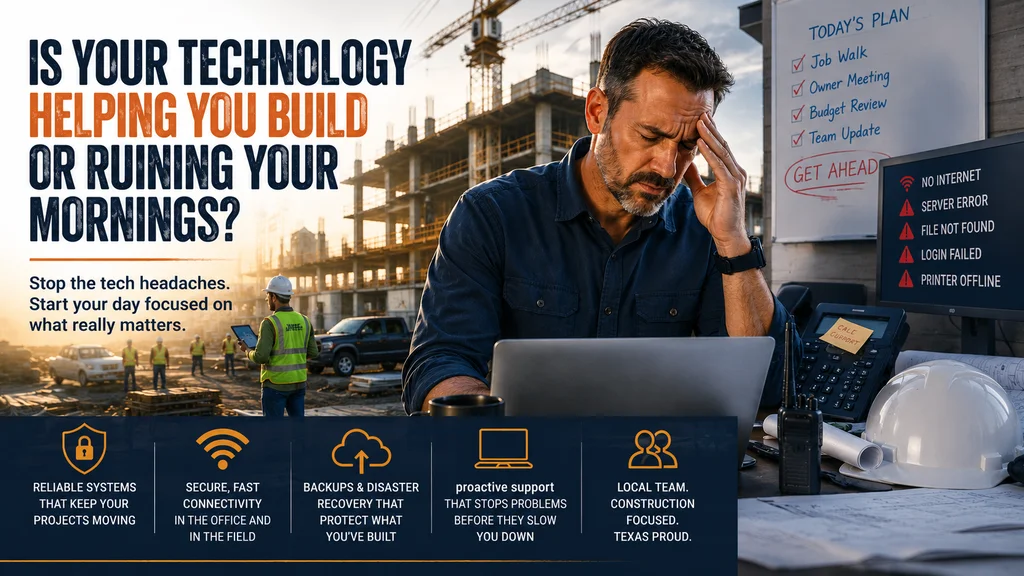
It’s Monday morning.
You’ve got coffee. You’ve got a full schedule. You’ve got crews moving, subs calling, owners asking for updates, and project managers already chasing answers.
This is the week you’re going to get ahead.
Then the phone starts buzzing.
“The job trailer Wi-Fi is down again.”
“The superintendent can’t open the latest drawings.”
“Accounting can’t log into the ERP system.”
“The project manager’s email has been syncing for 30 minutes.”
“The printer won’t print the bid package.”
“The tablet in the field needs an update before it will work.”
It’s not even 10 AM, and your team has already lost momentum.
Sound familiar?
That’s the problem with bad technology in construction. It rarely announces itself with flashing lights and sirens. Most days, it just shows up as a pile of small problems that drag your people away from the work they actually need to do.
And in construction, small delays do not stay small for long.
Nobody Started a Construction Company to Babysit IT
You got into this business to build.
Maybe you started in the field. Maybe you came up through project management, estimating, operations, finance, or ownership. However you got here, the job was never supposed to be resetting routers, chasing software vendors, hunting for missing files, or trying to figure out why a laptop will not connect before an owner meeting.
Nobody handed you a job description that said:
“Also, you’re IT now.”
But for a lot of construction companies, that’s exactly what happened.
The office manager becomes the printer expert.
The project manager becomes the Procore troubleshooter.
The estimator becomes the software workaround guy.
The superintendent becomes the hotspot technician.
The operations leader becomes the person everyone calls when technology gets in the way.
That is not a technology strategy.
That is survival.
It’s Not Just Your Morning. It’s Everyone’s.
One tech issue is annoying.
Ten tech issues across five jobs can quietly burn through an entire day.
A superintendent loses 20 minutes trying to download updated drawings.
A project manager misses an email because Outlook is stuck syncing.
Accounting gets locked out of a system because multi-factor authentication is tied to an old phone number.
An estimator wastes time searching through folders labeled “Final,” “Final Revised,” and “Final Final.”
A field team uses personal devices because the company tablet is too slow to bother with.
Nobody tracks all of that.
Nobody adds it to the job cost report.
But everybody feels it.
Your team came in ready to work. By mid-morning, they are frustrated, behind, and building workarounds around systems that should have worked in the first place.
That frustration becomes background noise.
People stop reporting problems because they assume nothing will change.
They create spreadsheets because systems do not sync.
They save files locally because the shared drive is a mess.
They text photos instead of using the right platform because it is faster in the moment.
They learn which steps to skip because “the system glitches if you do it the normal way.”
Now, here’s the kicker:
The more your people adapt to bad technology, the harder it gets to see how much it is costing you.
The Slow Leak Most Construction Companies Normalize
Most construction companies do not have catastrophic IT failures every week.
They have slow leaks.
Logins that take too long.
Wi-Fi that usually works.
Tablets that are almost useful.
Software that technically functions but does not make anyone faster.
Systems that do not talk to each other.
Updates that get ignored because nobody has time.
Backups nobody has tested.
Permissions nobody has reviewed.
A file structure nobody wants to explain.
Individually, each issue feels minor.
But stack them across your office, your project managers, your field teams, and your job sites, and you are not looking at a small nuisance anymore.
You are looking at lost hours, delayed decisions, frustrated employees, and unnecessary risk.
In construction, that matters.
Because every delay has a ripple effect.
A missed update can delay a decision.
A delayed decision can slow a crew.
A slow crew can affect the schedule.
A schedule problem can hit the margin.
And margin is where the truth shows up.
What You Actually Want From Your Technology
You probably do not wake up thinking, “I need a more advanced network infrastructure.”
You do not want a long lecture about cloud migration.
You do not need someone to explain cybersecurity in a way that makes your eyes glaze over.
What you want is simple.
You want to walk in on Monday morning and not think about technology at all.
You want the job trailer connection to work.
You want your team to access the latest drawings.
You want project files organized and protected.
You want accounting systems running.
You want emails syncing.
You want devices patched.
You want backups handled.
You want someone else dealing with the printer, the router, the login problem, the failed update, and the strange error message nobody understands.
You want your people building, managing, estimating, billing, and leading.
Not babysitting IT.
That is not asking for luxury.
That is the baseline.
Why It Still Feels Like This
Most construction technology problems are not there because someone made one terrible decision.
They are there because technology was added one piece at a time.
A project management platform here.
An accounting system there.
A new printer when the old one died.
A few tablets for the field.
A shared drive that started simple and became a junk drawer.
A Wi-Fi setup that made sense three offices ago.
A cybersecurity tool someone installed because insurance required it.
A backup system nobody has looked at in months.
Each decision probably made sense at the time.
But nobody stepped back and asked:
Does all of this work together?
Does it support how our teams actually operate?
Is it secure?
Is it efficient?
Is it helping the field move faster?
Is it reducing frustration or creating more of it?
That is the difference between technology that is accumulated and technology that is designed.
Accumulated technology keeps the lights on.
Designed technology helps the business move forward.
This Is an Operations Problem, Not Just an IT Problem
Too many companies treat IT like a repair service.
Something breaks. You call someone. They fix it. Everybody moves on.
Until the next thing breaks.
That is not enough anymore.
Construction runs on information. Drawings, RFIs, schedules, budgets, change orders, bids, contracts, photos, reports, approvals, and owner communications all depend on technology working the way it should.
So when your systems are slow, disconnected, unsecured, or poorly supported, that is not just an IT issue.
It is an operations issue.
It affects productivity.
It affects communication.
It affects client confidence.
It affects risk.
It affects profitability.
That is why the conversation has to get bigger than “Can you fix this laptop?”
The better question is:
Is our technology helping us run cleaner, faster, and safer?
A Quick Gut Check for Your Management Team
Before your next leadership meeting, ask these questions:
- Do our mornings regularly start with small tech fires?
- Are our project managers or office staff constantly solving technology problems?
- Have our field teams built workarounds because the official systems are too slow or clunky?
- Do we know whether our backups are actually working?
- Do we know which devices are outdated or unprotected?
- Do we know who has access to project files, financial data, and client information?
- Do our systems support the way our teams really work?
- Has anyone reviewed our full technology environment in the last 12 to 18 months?
Not just antivirus.
Not just passwords.
The whole picture.
Hardware. Software. Security. Backups. Connectivity. Workflows. Integrations. Support. Field access. Office productivity.
If the honest answer is no, then your technology may be helping your company cope instead of helping it grow.
Let’s Make Monday Boring Again
Technology should run quietly in the background.
You should walk in Monday morning thinking about schedules, clients, crews, bids, revenue, and growth.
Not routers.
Not restarts.
Not missing files.
Not software glitches.
Not another support ticket that may or may not get answered before lunch.
A boring Monday morning is a beautiful thing.
It means your systems are working.
Your people are moving.
Your field teams have what they need.
Your office is not stuck in workaround mode.
Your management team can focus on the business instead of the technology behind it.
That is what good IT should do.
It should make the work easier.
Not louder.
Where We Come In
We help construction companies across Texas stop carrying the weight of messy, reactive IT.
We look at your technology the way you look at a job site: what is working, what is slowing things down, what is unsafe, what is out of sequence, and what needs to be fixed before it turns into a bigger problem.
That includes your hardware, software, job-site connectivity, cybersecurity, backups, cloud systems, user access, support process, and daily workflows.
No jargon.
No scare tactics.
No shiny tools you do not need.
Just practical IT support built around how construction actually works.
If your team is tired of starting the week with tech fires, we’d be glad to take a look.
Call us at 214-253-0643 or schedule a discovery call.
You built your business to build.
Your technology should make that easier.