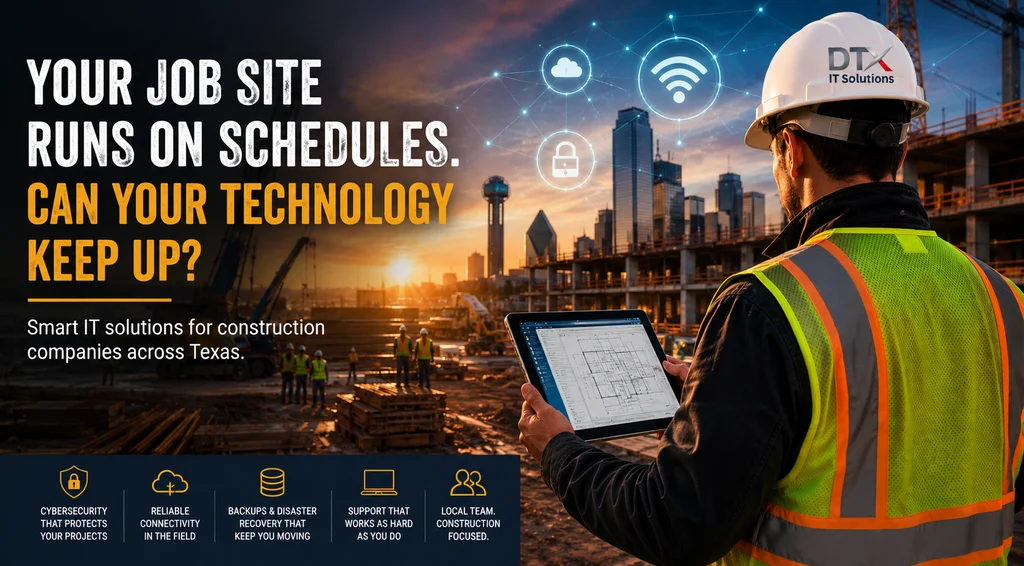
There was a time when construction ran on clipboards, carbon copies, two-way radios, and a superintendent who somehow remembered everything.
Now?
Your projects run on tablets, cloud software, digital drawings, RFIs, punch lists, shared folders, email approvals, mobile hotspots, accounting systems, estimating platforms, and a dozen other tools that all need to work together.
That’s the world now.
And here’s the problem:
A lot of construction companies are still treating their technology like it’s a job trailer printer from 2007.
Kick it. Restart it. Work around it. Hope it holds through Friday.
But hope is not an IT strategy.
For a construction company, poor technology gets expensive fast. Because when your tech lags, it does not just frustrate somebody at a desk.
- It slows down the field.
- It delays answers.
- It puts project data at risk.
- And it quietly eats into your margins.
Construction Does Not Have Room for “Good Enough” IT
Most management teams would never tolerate a crew standing around because nobody ordered the right material.
You would not ignore a machine that keeps breaking down.
You would not accept a subcontractor who shows up late every Tuesday and says, “Well, that’s just how we do it.”
But plenty of companies tolerate technology problems every single day.
A project manager waits five minutes for a laptop to boot.
A superintendent cannot pull up the latest drawings because the site connection is weak.
An estimator loses time hunting through folders named “Final,” “Final Revised,” and “Actual Final.”
Accounting re-enters the same data because two systems do not talk to each other.
A laptop keeps asking for updates, and somebody keeps clicking “remind me tomorrow.”
Now, here’s the kicker.
None of those feel like a major disaster in the moment. They feel like annoyances. Normal business friction. Just another Tuesday.
But those little delays stack up.
And in construction, stacked-up delays turn into missed deadlines, irritated owners, frustrated crews, and thinner margins.
How IT Messes Usually Happen
Nobody wakes up and says, “Let’s build a messy technology setup that slows everybody down.”
It happens the same way clutter builds up in a job trailer.
One tool gets added because somebody needed it fast.
Another system gets added for accounting.
Then estimating.
Then project management.
Then file sharing.
Then a cybersecurity tool.
Then a workaround for the workaround.
Each decision may have made sense at the time. But over the years, your technology stops being designed and starts being piled up.
That is where the trouble starts.
Your systems may technically “work,” but they do not work cleanly.
They do not talk to each other.
They do not support the way your teams actually operate.
And nobody is watching the whole setup closely enough to see where the waste is hiding.
That is not a technology plan.
That is accumulation.
And accumulation gets expensive.
The Real Cost Is Not Always a Big Outage
Sure, a server crash or ransomware attack will get everyone’s attention.
But most IT waste is quieter than that.
It shows up as:
- Slow logins
- Dropped video calls
- Missing files
- Bad Wi-Fi at the job site
- Software that requires double entry
- Field teams using personal devices because company tools are too clunky
- Project managers making decisions from outdated information
- Executives getting reports that are already stale by the time they land
Ain’t nobody got time for that.
Especially not your management team, who is trying to keep jobs moving, protect margins, and keep clients confident.
The hard part is that most of this waste gets treated like the cost of doing business.
But it is not.
It is the cost of neglected IT.
“It Works Fine” Is Not the Same as “It Works Right”
Ask most construction leaders about their technology and you will hear some version of:
“It works fine.”
Fair enough.
But does it work the way it should?
Can your team pull up the latest drawings from the field without fighting the connection?
Are your backups running and tested?
Are your devices patched and protected?
Can you lock down a lost laptop before project data walks off with it?
Do your systems help your people move faster, or do your people spend half the day working around them?
Can your management team see what is happening across jobs without chasing five different reports?
That is the better conversation.
Because in construction, technology should not be another thing your people have to babysit.
It should be part of the foundation.
Your Field Teams Need More Than Office IT
Construction IT is different.
A regular office has desks, predictable internet, controlled devices, and people sitting in one place.
Construction has job trailers, muddy sites, remote locations, mobile crews, rugged devices, subcontractors, tablets, hotspots, and people who need answers now.
That changes the game.
Your IT has to support the office and the field.
It has to protect sensitive project data, contracts, drawings, bids, financials, and client information.
It has to support tools like Procore, PlanGrid, Microsoft 365, estimating software, accounting systems, and whatever else your team depends on.
It has to help your people work from wherever the job is happening.
And it has to do all of that without turning every small issue into a support ticket that sits unresolved while the clock runs.
A Quick Gut Check for Your Management Team
Before your next leadership meeting, ask these questions:
- Do we know which devices are outdated?
- Do we know whether our backups worked last week?
- Do we know who has access to our project files?
- Do we know whether every laptop, tablet, and workstation is patched?
- Do we know where our biggest technology slowdowns are?
- Do our systems make the field faster, or just the office more complicated?
- Could we keep operating if our main server, cloud account, or internet connection went down?
If those questions make the room uncomfortable, good.
That means you found something worth fixing before it turns into something expensive.
Better IT Is Not About Buying More Stuff
This is where a lot of vendors get it wrong.
They show up trying to sell more software, more dashboards, more tools, more subscriptions, more noise.
But most construction companies do not need more technology.
They need better-aligned technology.
They need someone to step back and look at the whole operation:
- What is outdated?
- What is redundant?
- What is unsecured?
- What is slowing down the field?
- What is creating double work?
- What should be automated?
- What needs to be backed up, monitored, patched, or replaced?
- What is putting the company at risk?
That is the difference between fixing random IT problems and building a real technology plan.
One keeps you reacting.
The other helps you run cleaner.
Where We Come In
We help construction companies stop tolerating technology that slows the job down.
That means we look at your systems, software, security, devices, backups, connectivity, and support process through the lens of how construction actually works.
Not theory.
Not buzzwords.
The real world.
Job sites. Deadlines. RFIs. Change orders. Mobile crews. Owners who want answers. Project managers who do not have time to fight a login screen.
Our goal is simple:
Keep your technology from getting in the way of the work.
No jargon.
No finger-pointing.
No shiny tools you do not need.
Just practical IT support built for builders.
If your team has been tolerating slow systems, spotty connections, messy file sharing, or support that only shows up after something breaks, it may be time for a closer look.
Call us at 214-253-0643 or schedule a quick 15-minute discovery call.