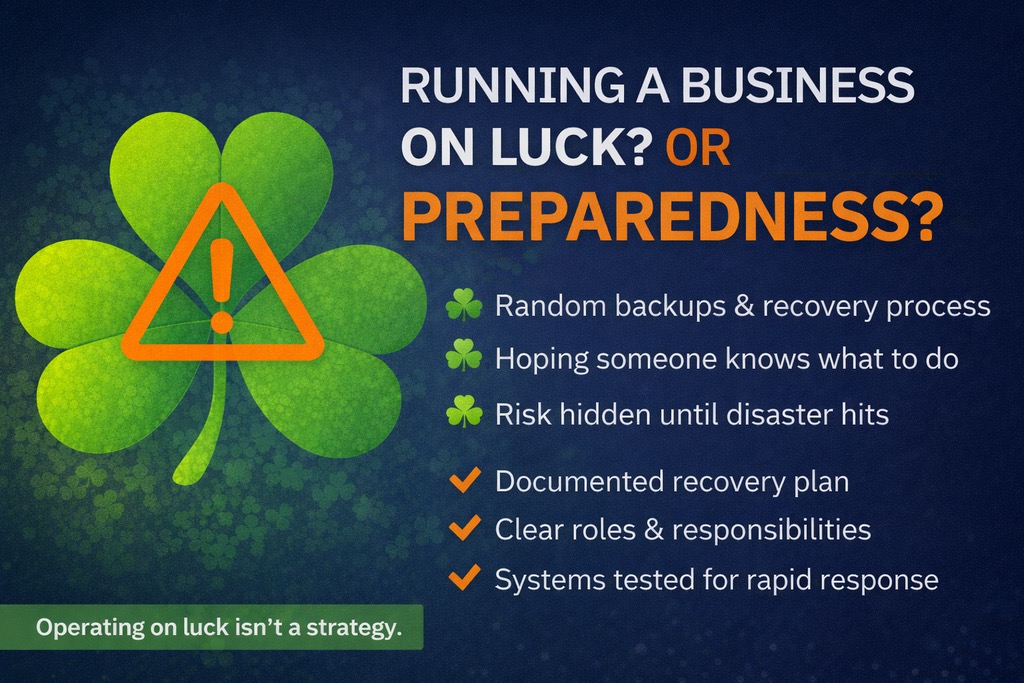
It’s March.
Green everywhere.
Shamrocks in store windows.
Everyone joking about luck.
Luck is fun.
It’s just not how serious construction companies run their operations.
Because no CFO would ever say:
“Our budgeting strategy is whatever feels right.”
Or an IT Director would say:
“Our cybersecurity plan is hope nothing happens.”
Or a project manager would say:
“Our safety plan is crossing our fingers.”
That would sound ridiculous.
But when it comes to technology recovery, many organizations unknowingly operate exactly that way.
This article is adapted from and reframed for construction leadership.
Where Technology Quietly Runs on Optimism
Most IT directors don’t intentionally run risky systems.
The reality is more subtle.
Over time, technology recovery becomes a mix of assumptions:
“We’ve never had an issue.”
“It’s probably backed up somewhere.”
“Our provider probably handles that.”
“We’ll deal with it if something happens.”
None of those are actually plans.
They’re just optimistic assumptions.
And optimism isn’t a strategy.
The Dangerous Logic of “We’ve Been Fine So Far”
Every organization that experiences a major system failure says the same thing beforehand:
“We’ve been fine.”
And they’re usually right.
Right up until the day they’re not.
Because the real problem isn’t how often things go wrong.
It’s how expensive they are when they do.
For construction firms, downtime doesn’t just affect one department.
It affects:
- project documentation
• accounting systems
• vendor payments
• project management platforms
• field reporting
• contract access
Which means one failure can stall multiple operations at once.
For the IT Director, that becomes a technical crisis.
For the CFO, it becomes an operational and financial one.
The Difference Between Prepared and “Probably Fine”
Most companies discover their level of preparation at the worst possible time.
Usually when someone asks questions like:
“Do we have a backup of this system?”
“How recent is that backup?”
“Who restores it?”
“How long will this take?”
Prepared organizations already know those answers.
Unprepared organizations find out in real time.
And real time can be very expensive.
The Double Standard Most Companies Don’t Notice
Think about where uncertainty isn’t tolerated in your company.
Hiring has structured processes.
Financial systems have controls and audit trails.
Project management follows defined workflows.
Safety procedures are documented and practiced.
But technology recovery?
In many companies, it quietly runs on hope.
Not because leadership is careless.
Because it’s invisible.
Until the moment it isn’t.
And invisible risk is still risk.
This Isn’t About Fear — It’s About Professional Discipline
Being prepared doesn’t mean expecting disaster.
It means eliminating guesswork.
It means knowing:
- what systems are backed up
• how quickly they can be restored
• who is responsible for recovery
• how operations continue during an outage
Prepared companies don’t panic when something breaks.
They execute a plan.
The interruption becomes manageable instead of chaotic.
A Simple Test for Leadership
Here’s a quick way to think about it.
If your accounting team managed the books the way many companies manage IT recovery, would that feel acceptable?
Imagine hearing:
“We’re pretty sure expenses are tracked somewhere.”
“I think the books were reconciled recently.”
“We’ll sort it out when tax season comes.”
No CFO would allow that.
So why does technology sometimes get a lower standard?
The Real Takeaway
Luck is great for St. Patrick’s Day.
It’s a terrible operating strategy.
Strong construction firms apply the same discipline to technology that they apply to finance, safety, and project management.
Because when something eventually breaks—and at some point it will—they don’t rely on luck.
They rely on preparation.
And preparation turns a potential crisis into a minor interruption.
A Quick Conversation Can Close the Gap
Your organization may already have strong recovery systems in place.
If that’s the case, you’re ahead of many companies.
But if parts of your environment still rely on “we’ll figure it out if it happens,” it may be worth a quick conversation.
No scare tactics.
Just a practical discussion about making sure your technology recovery is held to the same professional standard as the rest of your business.