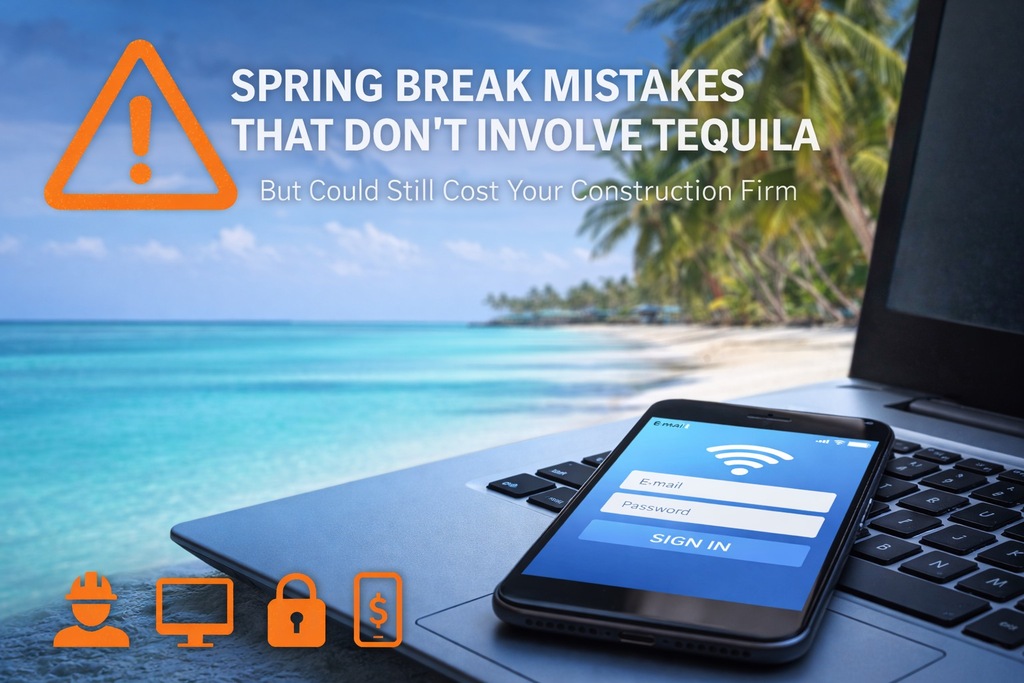
But Could Still Cost Your Construction Firm
Spring break gets a bad reputation.
College kids. Questionable decisions. Stories that start with, “We thought it was a good idea at the time…”
But in construction leadership?
Our spring break mistakes don’t involve tequila.
They involve technology.
And they don’t show up on Instagram.
They show up later — in breach reports, compliance reviews, and budget meetings.
If you’re the IT Director, you’ve probably worried about this.
If you’re the CFO, you’ve definitely paid for it before.
Let’s talk about the quiet vacation tech mistakes that can follow your business home.
The “Free Wi-Fi Will Be Fine” Assumption
You’re at the hotel. You just need to send one email. Maybe approve a pay app. Maybe check a project schedule.
So, you connect to “Hotel_Guest_WiFi.”
Seems harmless.
Except fake networks are easy to set up, and construction firms are high-value targets. Contracts. Wire transfers. Payroll. Vendor payments.
For the IT Director, that’s credential exposure.
For the CFO, that’s potential wire fraud.
One intercepted login can lead to six-figure losses especially in an industry where payment flows are constant.
Smarter move: Use a hotspot for anything tied to company systems. Sensitive access doesn’t belong on public networks.
The “I’ll Just Log In Real Quick” Spiral
One email turns into:
- The project management platform
- Accounting software
- Vendor portals
- CRM
- Slack
All from a hotel balcony while the family waits for dinner.
Every login is a doorway.
And when you’re rushed, you’re less cautious.
IT Director’s knows this: security failures rarely happen during calm, controlled moments.
They happen when someone is distracted.
The CFO knows this too: breaches don’t care whether you were “just checking something quickly.”
Smarter move: If it truly can’t wait, use secure access only. Otherwise? Let it wait 48 hours.
If your systems collapse because you unplugged for two days, that’s a bigger problem.
The “Kids Can Use My Phone” Risk
You hand your phone to your kid during downtime.
Next thing you know, they’ve downloaded three apps and accepted every permission request without reading a single word.
Seems small.
But if that device has company email, saved passwords, or access to cloud platforms, you’ve just widened your attack surface.
For the IT Director, that’s unmanaged endpoint risk.
For the CFO, that’s liability tied to something that looked harmless.
Smarter move: Keep work access on dedicated devices. Separate personal and company environments.
The Overshare
“I’m in Cabo until the 15th!”
Location tagged. Big smile. Ocean in the background.
It feels fun.
But it also tells the world:
- You’re away
- Your home is empty
- Your office might be short-staffed
Cybercriminals use social cues too. Travel posts often correlate with targeted phishing attempts, especially impersonation attacks aimed at finance teams.
Imagine a fake “urgent wire” request hitting accounting while leadership is out of town.
For the CFO? That’s a nightmare scenario.
Smarter move: Post the vacation photos when you get home.
The Airport Charging Station
Phone at 3%. Boarding soon. USB port right there.
Plug in.
“Juice jacking” isn’t just a buzzword. Compromised ports can attempt data transfer while charging.
If that device connects to company systems, it becomes a possible entry point.
Construction firms already deal with field device risk. Why add airport risk to the list?
Smarter move: Bring your own charger. Your own cable. Your own power brick.
The Bigger Issue: It’s Not About Vacation
None of these mistakes happen because leaders are careless.
They happen because leaders are busy.
Distracted.
Trying to balance family and responsibility.
And that’s exactly when attackers strike.
For the IT Director, this is about protecting infrastructure beyond the office walls.
For the CFO, this is about protecting margin, reputation, and operational continuity.
Because in construction, disruption has ripple effects:
- Delayed payments
- Project slowdowns
- Compliance exposure
- Lost client confidence
And those costs rarely show up as “IT mistakes.”
They show up as operational losses.
The Real Question
If your firm relies on:
- Public Wi-Fi
- Shared passwords
- Unmanaged devices
- “Hope nothing happens” travel habits
Is that risk priced into your budget?
Or are you assuming luck is a strategy?
Strong construction firms don’t just harden job sites.
They harden digital access, especially when leadership travels.
Before You Head Out
If your security practices are solid, enjoy the beach.
If reading this made you slightly uncomfortable, that’s not fear. That’s awareness.
A quick 15-minute conversation can clarify:
- Are your travel policies secure?
- Is remote access hardened?
- Are financial workflows protected from impersonation attacks?
- Would a short vacation expose structural weaknesses?
No scare tactics.
Just practical strategy.
Because vacation should lower your stress, not increase your company’s risk exposure.